PHLOX: AN EXPLORATION

PHLOX SPECIES AND CULTIVARS

Primrose Path Home

Introduction

What is a Phlox?

Horticultural History

Basis of Breeding

List of Medium-size Phlox

List of Moss Phlox

References


In this section I will discuss the species and cultivars of Phlox primarily from a horticultural and natural history point of view. I am using genus section divisions that reflect that rather than strict taxonomy and listing species and cultivars alphabetically within each section for the sake of ease of reference. For botanical descriptions and keys see Wherry 1955 and other texts. The taxonomy follows the USDA Plants Database, except for P. ovata, which has recently been changed back from P. latifolia. There is excellent information on cultivation and propagation of the smaller phlox in Foster and Foster 1990.

     Large Phlox - Maculata Group
These species all seem to fall into a single natural group.

Phlox amplifolia
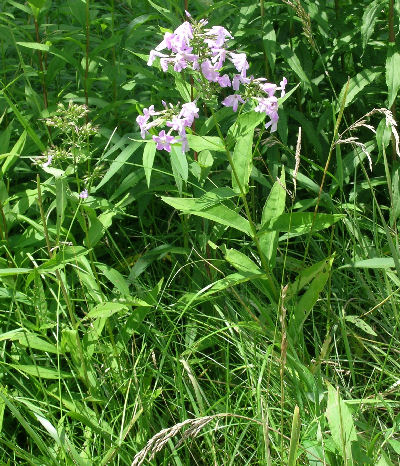
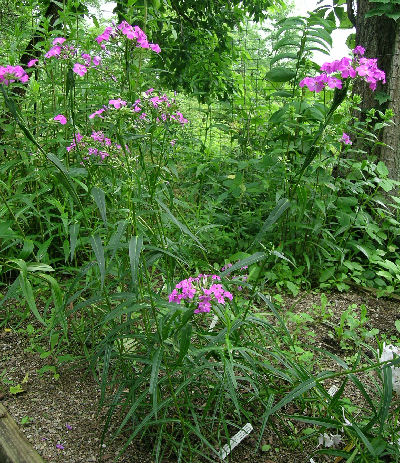
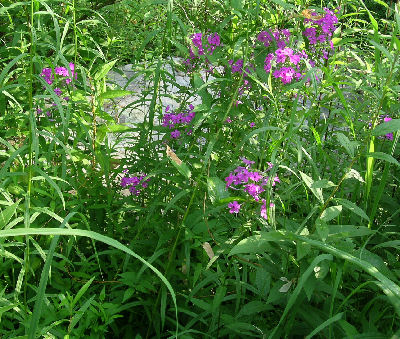
(Large-leaf phlox) - Range: Southern Midwest, Indiana to Alabama, west to Missouri. Habitat: moist open woods and roadsides. Bloom time: late spring to early summer. Height: to about 150cm. Flower color: pink to purple. Bloom time: late spring to early summer. This species has not been used horticulturally and is related to P. paniculata, as evidenced by the presence of marginal veins in the leaves. In Tucker Co., northern West Virginia, there is a phlox that appears to be P. amplifolia but differs in that the leaves are wide-linear rather than rhomboidal, and the inflorescence lacks glandular pubescence. This blooms in early June and has pink-purple flowers.

Phlox carolina (Carolina phlox) - Range: North Carolina to southern Illinois and south to the Gulf of Mexico. Habitat: open woods and meadows. Height: from 45cm to about 200cm. Bloom time: early to mid summer. Flower color: pink to red-purple. The flowers are borne in loose, dome-shaped panicles. Current taxonomic treatments of P. carolina make it a variable species that includes widely differing forms. I have seen only P. c. ssp. carolina in nature. This was in the Blue Ridge of western North Carolina, where it grew most commonly along the Blue Ridge Parkway at 4000 to 5000ft on roadside banks and in openings in well-drained acid soil, blooming in July and August. There are photos on a separate page. This is a very different habitat from those of P. g. ssp. glaberrima and P. glaberrima ssp. interior and P. maculataP. carolina ssp. angusta is small, with narrow leaves, whereas P. carolina spp. alta is very large. A few cultivars have been selected from wild-type populations.
     'Bill Baker' see P. glaberrima ssp. triflora 'Morris Berd'.
     ssp. angusta 'Gypsy Love' is a selection made by North Creek Nurseries that is 45-60cm tall and has red-purple flowers resembling those of the narrow-leaved P. glaberrima taxa.
     ssp. carolina 'Kim' is a new cultivar reportedly 45-60cm tall with pink flowers. I have not seen this bloom yet, but my plants have a relatively lax habit and leaves that are a little narrower than those of the Blue Ridge Parkway P. carolina.
     'Magnficence'- All of the plants I have seen look like P. maculata 'Alpha'. I do not know if there is another plant that is different.
     'Miss Lingard' see P. maculata 'Miss Lingard'.
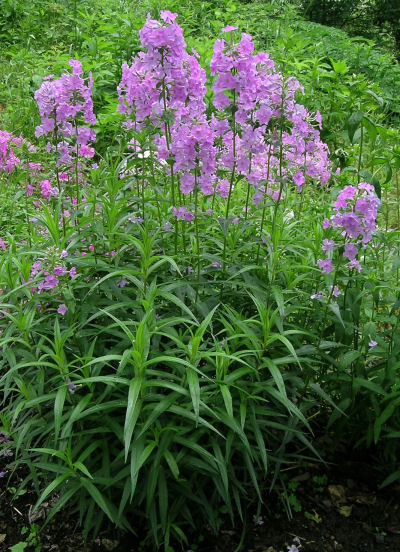
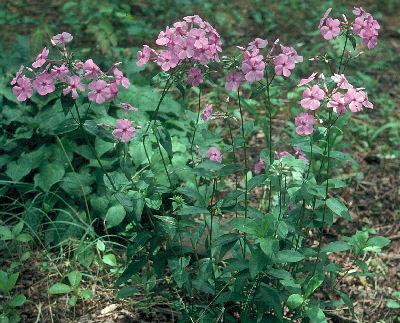
Phlox amplifolia, Canaan Valley, WV
Phlox carolina
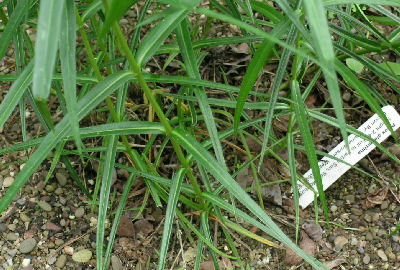
Phlox glaberrima ssp. glaberrima and ssp. interior (Smooth phlox) - Range: Virginia to Illinois south to Tennessee and Arkansas. Habitat: moist open woods to marshes. Height: 40to 150cm. Bloom time: late spring to early summer. Flower color: pink to purple. The flowers are borne in very open panicles. These are narrow-leaved, long-stemmed, gawky plants that require constant moisture to do well in cultivation.
     'N³ Springfall' is a selection from Nearly Native Nursery in Fayetteville, GA. This is about 75cm tall with red-purple flowers in early summer. The nursery calls it a "strange form," but it is similar to other P. glaberrima we have seen. It is also supposed to bloom into the fall but did not do well for us and died down by September, probably because the site was too dry.

Phlox glaberrima ssp. triflora (Three-flower phlox) - Range: Maryland to Indiana, south to Georgia and Alabama.
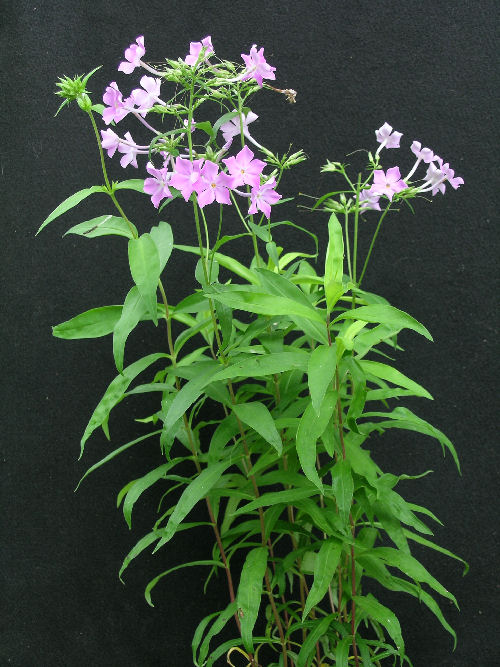
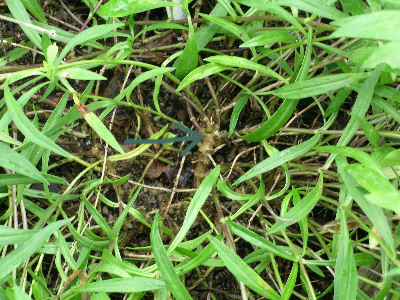
Habitat: open woods. Height: 40 to 60cm. Bloom time: late spring. Flower color: pink to purple. The flowers are borne in groups of threes in a nearly flat-topped panicle. Judging by all the garden material I have seen, this taxon seems to have little to do with P. glaberrima and is probably a separate species more closely related to P. pulchra and/or P. ovata. Wherry's (1955) key uses the trait of flowering shoots arising from decumbent stems to separate P. pulchra and P. ovata from the other tall phlox, and by this P. g. ssp triflora belongs with those two species. This is the best of the maculata group of phlox for naturalizing in garden situations, since it will self-seed into drifts and thrives in a range of well-drained soils in sun to partial shade. P. g. ssp. triflora, P. ovata, and P. pulchra have been confused in botany and horticulture, and their genetic relationships are not yet clear. It is possible, of course, that none of the plants in horticulture is really P. g. ssp triflora at all.
     'Anita Kistler' - This is similar to 'Morris Berd,' but the flower color reportedly tends toward lilac.
     'Morris Berd' - This selection has become a deservedly popular garden plant. It differs from the wild type in having larger flowers of a more pleasing pink. The original plant was given to Morris Berd by Edgar Wherry and later introduced by Don Hackenberry of Appalachian Wildflower Nursery. According to Morris Berd, it was considered P. pulchra by Edgar Wherry, but the basal foliage is quite different from the P. pulchra now in horticulture.        
     'Bill Baker' appears to be the same clone as 'Morris Berd' taken to England and named there.
     'Triple Play' is a variegated form with white-margined leaves from Joe Pye Weed's Garden in Massachusetts.
Phlox glaberrima ssp. interior
P. g. ssp interior crown lacks decumbent stems P. glaberrima ssp. triflora decumbent stem (arrow) Phlox glaberrima ssp triflora
Phlox idahonis (Idaho phlox) - Range: central Idaho. Habitat: moist, grassy meadows. Height: 50 to 100 cm. Bloom time: early summer. Flower color: lilac to lavender. This is a narrow endemic that has never entered horticulture. It appears to be related to P. maculata and P. carolina.

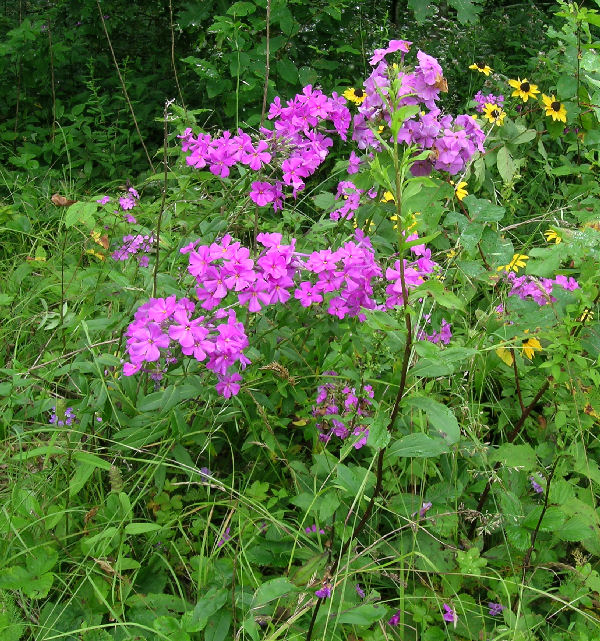
Phlox maculata (Meadow phlox) - Range: southern Quebec to northern Georgia west to Minnesota and Missouri. Habitat: moist meadows and stream banks. Height: 60 to 120cm. Flower color: Purple-pink. Bloom time: late spring to mid summer. This species is distinguished by its cylindrical inflorescence and maroon-spotted stems. There are two recognized subspecies: P. m.ssp. maculata has fewer leaf nodes and blooms late spring to early summer; P. m. ssp. pyramidalis has more numerous leaf nodes and blooms in mid summer. The latter appears to be derived from hybridization with P. glaberrima (Levin 1963).  It is difficult to assign garden cultivars to one subspecies or the other. All of the following cultivars are badly afflicted with mildew unless they are in moist or even wet soil with sun exposure.
     'Alpha' - This selection was raised and introduced by Georg Arends early in the 20th century. I am dubious that the form currently available in the US under this name is the true plant, since the flower color of 'Alpha' is described as "a soft but telling pink" (Bloom 1991) and those of the plant I have seen are a harsh magenta. This is about 90cm tall.
      'Miss Lingard' - This is usually listed in catalogs as P. carolina, but the cylindrical inflorescence indicates P. maculata.  It has been found to be a sterile triploid (Meyer 1944), but this need not indicate hybrid ancestry, as Locklear (2011) says. 'Miss Lingard' is a handsome pure white about 75cm tall.
     'Flower Power' (PP#17,551) - A seedling of 'Omega,' this vigorous cultivar was bred by Darrell Probst and introduced by Blooms of Bressingham. It has white flowers flushed with light pink-purple and reaches 90-120cm.
     'Natascha' is a form with the petals variegated with the center pink and margins white. This is essentially the same coloration as P. subulata 'Tamonongalei' aka 'Candy Stripe.'  
     'Omega' - This was introduced by Alan Bloom in 1966 and is about 90-120cm tall. The large white flowers have a light pink eye ring; 'Omega' is by far the most beautiful of the white P. maculata cultivars.
     'Rosalinde' - This is a cultivar about the same size as 'Miss Lingard', with magenta pink flowers.        
Phlox ovata
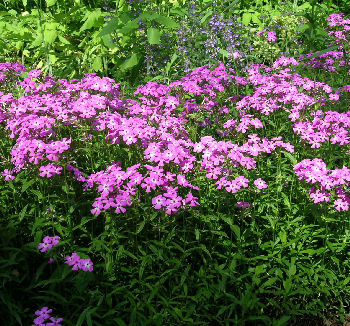
Phlox maculata along the Youghiogheny River, Fayette Co., PA

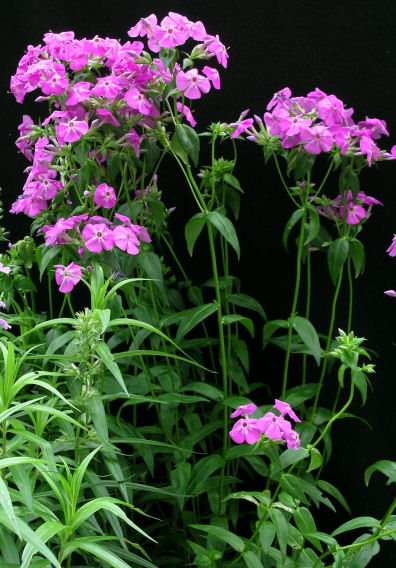
Phlox maculata 'Flower Power' wild-type Phlox maculata cylindrical inflorescence
Phlox ovata (Wide-leaf phlox) - Range: Pennsylvania to northern Georgia; Ohio and Indiana. Habitat: moist to dry open woods. Height: 30 to 45cm. Bloom time: late spring. Flower color: pink to pink-purple. This species has ovate leaves arising from thick procumbent stems and attractive flowers in flat-topped panicles. It has done well for us in a sandy raised bed in partial shade. This species is hardly ever seen in gardens, but there seems potential for selection of attractive clones. 

Phlox paniculata
(Border phlox) - Range: Pennsylvania to Illinois and south to northern Georgia and Arkansas. Habitat: mainly in woods along streams and rivers. Height: 90-120cm. Flower color: pink to purple-pink. Bloom time: mid to late summer. P. paniculata is the phlox species that has been most subjected to breeding and selection. There are hundreds of cultivars, and I will not attempt to deal with them. References such as Armitage 2006 and Rice 2006 give good reviews. Selections are often falsely referred to as hybrids.

Phlox pulchra (Alabama phlox) - Range: north-central Alabama. Habitat: margins or openings in woodland. Height: 25 to 50cm. Flower color: pink to purple.  This species has ovate leaves and a growth habit similar to that of P. ovata. It is undeservedly almost unknown in gardens.
     'Eco Pale Moon' - This selection from Don Jacobs at Eco Gardens has light pink flowers.
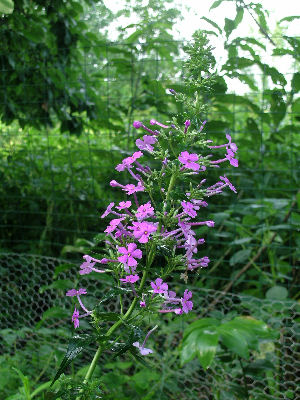
Phlox pulchra

Hybrids
- Surprisingly few of the the phlox garden cultivars are hybrids. There have been persistent rumors that Georg Arends made P. paniculata × P. maculata hybrids in the early 20th century and that these are part of the P. paniculata cultivar line-up. Arends may have made this cross, but no cultivar that I have seen could be a hybrid of this parentage. Arends is also supposed to have made crosses between P. carolina and P. maculata (Aniśko 2008), but these do not seem to be present in any obvious way in horticulture today.

Arendsii hybrids - These are the result of crosses between P. paniculata and P. divaricata and are 30 to 60cm tall. The plants combine the relatively low stature of P. divaricata with the colors of P. paniculata garden selections. The original hybrid was bred by Georg Arends in the 1920s and is available today as 'Anya,' which has magenta pink flowers. New Dutch selections include 'Luc's Lilac' and the Spring Pearl Series ('Miss Jill,' 'Miss Karen,' 'Miss Margie,' and 'Miss Mary'), named for the office staff at the DeVroomen company, and with white, dark pink, lilac-blue, and rosy-red flowers,
respectively.

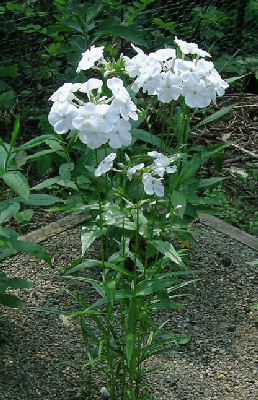
'Minnie Pearl' - This beautiful selection was found in Kemper Co, east-central Mississippi, and appears to me to be perhaps a P. glaberrima × P. carolina hybrid. It is about 60cm tall and has masses of large white flowers for a long period from late spring into summer.

'Spring Delight' - This is about 45cm tall and blooms in late spring with magenta flowers. The habit and foliage is generally like that of P. pulchra, but it is less attractive and vigorous, and it might be a P. pulchra × P. ovata or P. g. ssp. triflora hybrid.  In catalogs it is often referred to as a hybrid between P. paniculata and P. stolonifera, but this seems very unlikely. There is a fairly similar, but more attractive plant distributed by Don Hackenberry of Appalachian Wildflower Nursery. I no longer have the plant and do not remember what name he used for it.

(next page - Medium phlox)
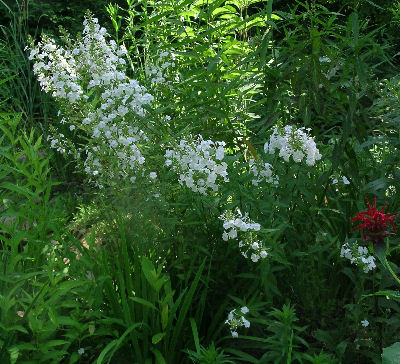
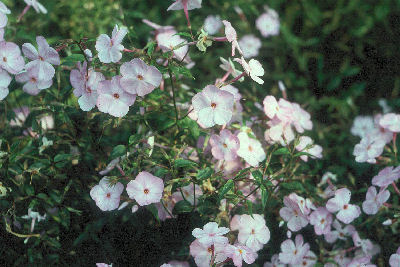
Phlox 'Minnie Pearl'
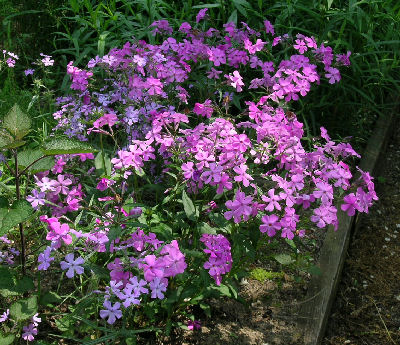
Hybrid (?) phlox from Don Hackenberry

[Introduction] [What is a Phlox?] [Horticultural History] [Basis of Breeding] [Accounts of Species and Cultivars] [References