|
Home
Butterfly
Wings
Elizabeth
Oliver
Pink
Brushes
Pink
Pearls
Running
Tiger
|
|
Featured
Plants
We
have included profiles of our favorite foamflowers, 'Elizabeth Oliver,'
'Butterfly Wings,' 'Pink Brushes,' 'Pink Pearls,' and 'Running Tiger.'
Origin
of Garden Tiarella
Tiarella
or foamflowers are native to the woodlands of North America and eastern
Asia. They are small plants with slightly hairy heart-shaped
leaves that form clumps or spread by runners to make patches. In spring
the plants give rise to spikes of starry white or pink flowers. In
eastern North America there are several different looking forms that
are currently combined under the name Tiarella cordifolia
in official taxonomic usage. For horticultural usage, though, it is
convenient to distinguish the forms as T. cordifolia,
T. collina, and T. wherryi.
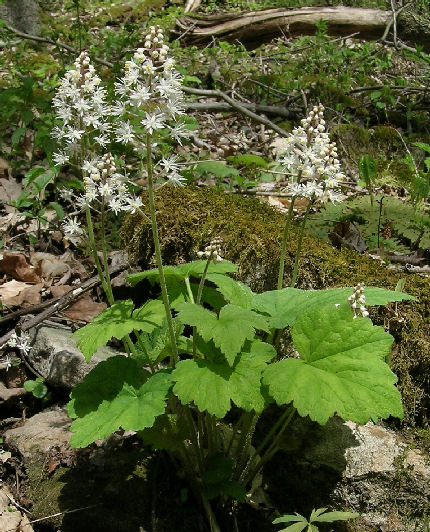
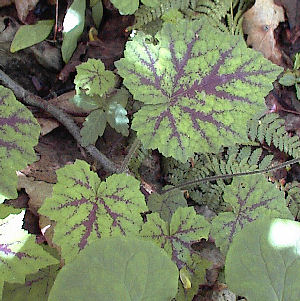
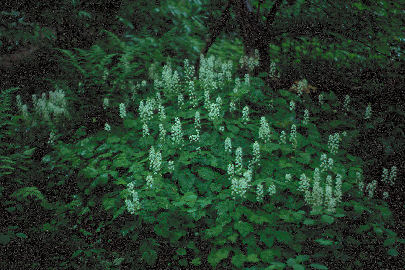
T. cordifolia, seen in the picture at right and the two
pictures below, is the small running Allegheny Foamflower, found from
New Brunswick and Ontario south to the mountains of North Carolina.
This is an excellent native groundcover, which makes a dense patch of
foliage that is often marked with attractive maroon patches. In spring
white or pale pink flowers on 12" spikes give a "foamy" appearance to
the plants.
|
 |
 |
 |
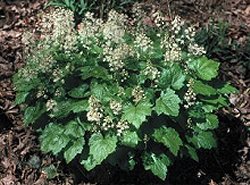 |
T. collina and T.
wherryi make larger clumps without runners. T.
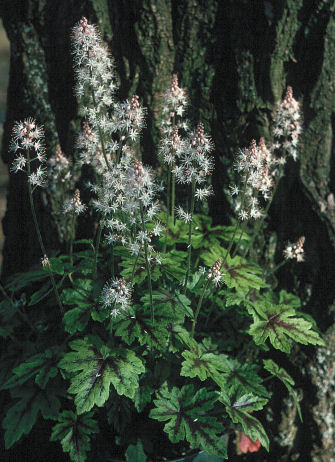
collina, seen left top, has glossy foliage, often with dark
stems, and substantial spikes of white or pink flowers to 18". T.
wherryi has matte foliage of a lighter green and white or
pink flowers to about 14 to 16". All of these varieties have forms in
which the foliage is deeply lobed rather than heart-shaped: in T.
cordifolia the small selection 'Slick Rock,' in T.
collina the form 'Excelsa,' and in T. wherryi
the selection named 'Oakleaf,' although the leaves are lobed like a fig
leaf rather than an oak. On the Pacific Coast are T.
trifoliata and T. unifoliata, which are
also currently lumped together, but can be treated separately for
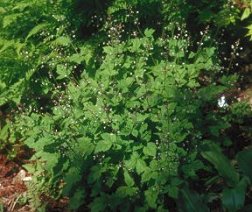
horticultural convenience. T. unifoliata is a
relatively large form with white flowers on 18" stems and rounded
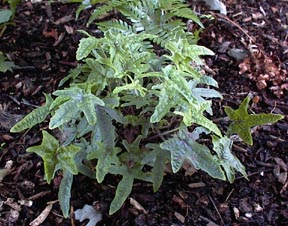
leaves. T. trifoliata, pictured on the left, is
smaller and has white flowers and leaves that vary from heart shaped to
three-lobed and in the form var. laciniata so
deeply cut as to be fully compound. Both of these types bloom from late
spring into the summer; unfortunately they are not very hardy in the
eastern United States. There is an additional species, T.
polyphylla, in eastern Asia. This has rounded leaves and
white to dark pink flowers. This has not proved a hardy plant in the
eastern US and has not been used as a hybrid parent of any commercially
introduced ciltivars. |
 |
Until
relatively recently the foamflowers have been grown almost entirely in
woodland gardens devoted to native plants. The richness of variation in
the group and the attractiveness of many forms gives them great
potential for development as mainstream garden perennials for use in
shaded sites, though, and in the late 1980s the hybrid crosses were
made at The Primrose Path that have provided the basic material for the
almost all of the new cultivars that have come onto the market in the
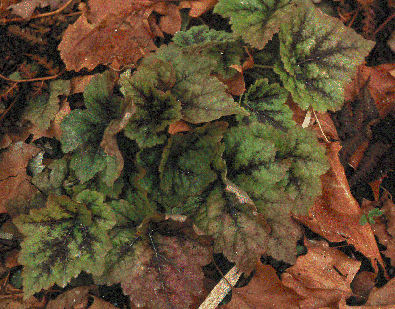
1990s.The first of these new cultivars was 'Tiger Stripe,' below left,
an exceptionally vigorous plant with seasonally variable maroon leaf
markings and light pink flowers. 'Tiger Stripe' was then combined with T.
trifoliata var. laciniata
to produce a
group of hybrids with variably cut foliage. One selection, 'Filigree
Lace,' was selected from this set hybrids and introduced to the trade.
Selection and additional crosses within this group produced
'Martha Oliver'and 'Elizabeth Oliver,' below middle. These were named
after the breeder's wife and daughter, respectively. Other breeders
have continued on from this stock to introduce a large number of
hybrids with foliage of various coloration and degrees of cutting. The
Primrose Path subsequently introduced 'Arpeggio' and 'Green Sword,'
below right. All of the Tiarella are valuable plants that can be used
to bring variety to the shade garden, complementing the delicacy of
ferns and lightening the weight of hosta and other coarse foliage.
|